


For years, social media and SEO lived in separate boxes.
SEO was “for Google.”
Social was “for engagement.”
Different teams.
Different goals.
Different metrics.
That split no longer exists.
In 2026, your social media content is part of how people find, judge, and choose your business.
Not later.
Not eventually.
Right now.
Welcome to Social SEO.
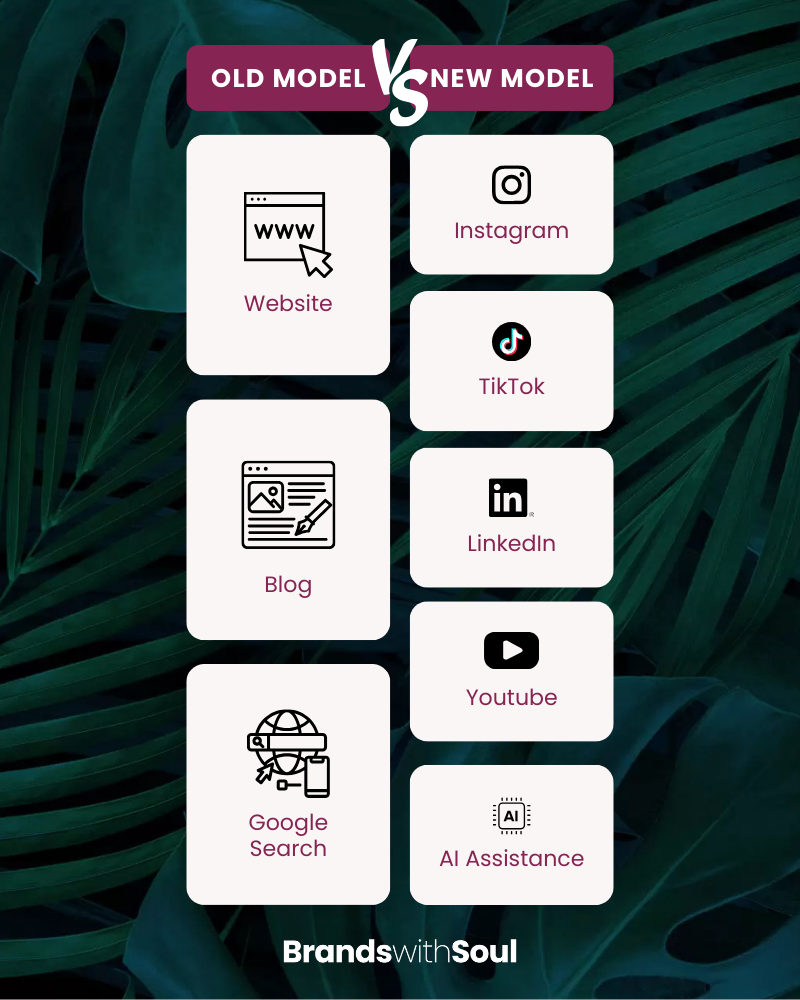
Search no longer starts and ends with Google.
What is Social SEO?
Social SEO is the practice of optimising your social media content so it:
- Appears in search results
- Answers real questions
- Builds trust before a website visit
- Supports AI, local, and voice search discovery
It’s not about hashtags.
It’s not about trends.
And it’s definitely not about going viral for the sake of it.
Social SEO is about visibility with intent.
If someone searches for:
- a service
- a solution
- an explanation
- a recommendation
Your social content should be able to meet them there and make sense instantly.
Why Social SEO matters now
People don’t just search on Google anymore.
They search on:
- TikTok
- YouTube
- Facebook Groups
- AI assistants pulling from social platforms
And here’s the uncomfortable part.
Most brands are still posting as if social media exists in a vacuum.
Pretty posts.
Vague captions.
Inside jokes.
Zero clarity.
If your social content doesn’t explain what you do, how you help, or who you’re for, search engines and humans both struggle to place you.
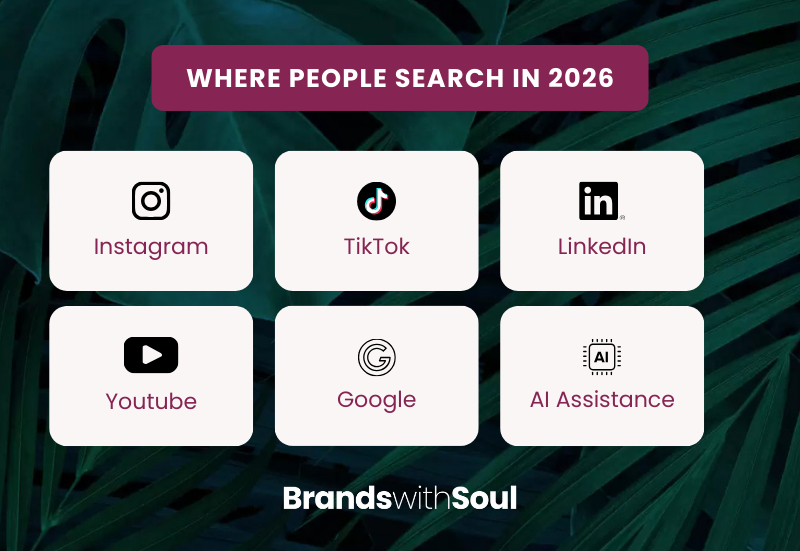
Search behaviour has fragmented. Visibility has to follow.
Social platforms are search engines now
Think about your own behaviour.
You search Instagram for:
- local businesses
- service providers
- recommendations
You search TikTok for:
- tutorials
- explanations
- reviews
You search LinkedIn for:
- expertise
- credibility
- authority
You are not scrolling aimlessly.
You’re looking for answers.
If your content isn’t searchable, structured, and clear, you don’t show up in those moments.
And those moments are when decisions are made.
How Social SEO actually works
Social SEO isn’t complicated.
It’s just intentional.
It focuses on:
- Keywords in captions, bios, and headlines
- Clear descriptions of what you do
- Consistent topics and language
- Answer-based content
- Strong profiles that mirror your website messaging
It rewards clarity over creativity.
That doesn’t mean boring.
It means understandable.
If your brand disappeared tomorrow, could someone explain what you do just by reading your social profiles?
If the answer is no, Social SEO is already failing.
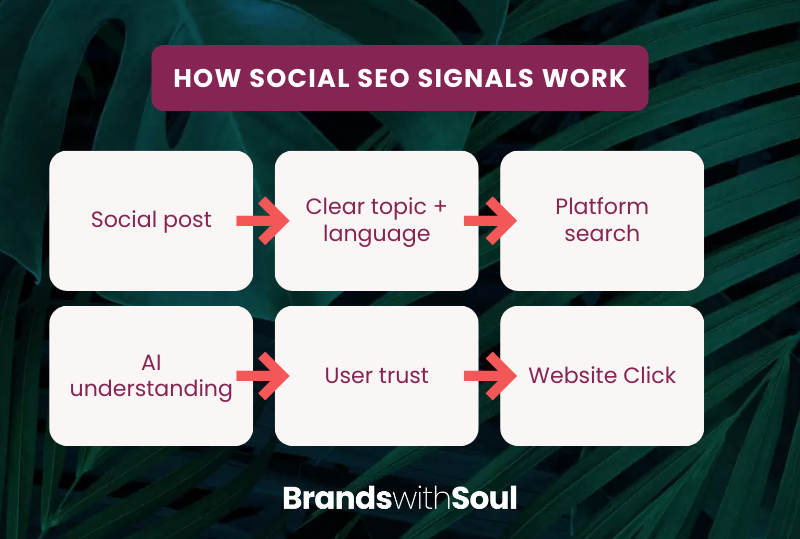
Your social content feeds both humans and machines.
The biggest mistake businesses make
They post content that looks good but says nothing.
Vague captions.
Trendy sounds.
Aesthetic visuals with no context.
It might get likes.
It rarely gets clarity.
If a stranger can’t tell what you do in five seconds, neither can an algorithm.
And algorithms are just pattern-recognising strangers at scale.
What Social SEO content actually looks like
High-performing Social SEO content:
- Answers common questions
- Explains processes simply
- Shows outcomes and proof
- Uses everyday language
- Is written for humans first
This is why educational content is outperforming polished brand posts in 2026.
Not because it’s louder.
Because it’s useful.
A lot of brands mistake “looking good” for being understood. Pretty content often comes with vague captions, aesthetic visuals, and very little explanation. Clear content does the opposite. It leads with a descriptive headline, uses plain language, and connects the problem directly to the solution. The truth is, clarity compounds over time. Aesthetics on their own don’t.
Social SEO and trust go hand in hand
Before someone clicks your website, they check your social presence.
They’re scanning for:
- consistency
- proof
- relevance
- confidence
Your social profiles act as a pre-qualification filter.
If they’re unclear, outdated, or inconsistent, people drop off before they ever convert.
Social SEO doesn’t just attract attention.
It reassures people they’re in the right place.
How Social SEO supports SEO, GEO, and AEO
Social content feeds:
- Search engine understanding (SEO)
- Location relevance (GEO)
- Answer engine visibility (AEO)
- Brand authority
Search engines and AI tools cross-reference your website, your social profiles, and your content themes.
If those messages don’t align, trust breaks.
Social SEO isn’t a replacement for SEO.
It’s reinforcement.
Visibility doesn’t live in one place anymore. Your website, social content, search engines, AI answers, and local results all feed into each other, constantly exchanging signals. Social media now sits right in the middle of that ecosystem, shaping how your brand is understood, surfaced, and trusted before someone ever clicks through. Visibility is layered, and social is no longer optional within it.
Why Social SEO isn’t a one-time fix
Search behaviour changes.
Language evolves.
Platforms shift.
Social SEO works best when:
- Content is reviewed
- Performance is monitored
- Messaging is adjusted
- Gaps are filled
This is why brands are moving away from random posting and toward ongoing optimisation retainers.
Not more content.
Better content.
The takeaway
If your social media exists purely for “engagement,” you’re leaving visibility on the table.
In 2026:
- Social is searchable
- Content is contextual
- Clarity wins
Social SEO isn’t about doing more.
It’s about making what you already post work harder.
So the question is:
Are your socials just filling space…
or helping people find you when it matters?
Still not sure how searchable your social media really is?
Let’s look at it together.
